


Writers with Dienece-Allyson Koekhoven

Welcome Dear Readers!
We've had a bit of a break from author interviews for the last 3 weeks, but now we're going to start back up with the remaining authors of the Our House on Jakaranda Laan series! I hope you're as keen to meet these last few authors as I've been meeting them myself.
This week, we meet the author of House #13, Allyson Koekhoven.


Hi, Allyson! It's so wonderful to actually see your face.
Readers, Allyson and I have been chatting through Facebook and Gmail throughout the year, and for much of that, I didn't even know what she looked like!
What have Allyson and I been chatting about, you ask? Well, our books in the Jakaranda Laan series are connected, even though they are set 250ish years apart.
How did we manage that? Well, we'll tell you later, but for now, let's learn a little bit about the author herself.
Why don't you start things off, Allyson, by telling my Readers what you write?
Allyson: Contemporary Christian fiction, although I do have a tendency to wander into other genres when a story refuses to behave itself!
[Dienece laughs] Books can have a way of misbehaving themselves. But when they aren't being mischievous, what are your books normally like?
Allyson: My books are generally centred around ordinary people dealing with decidedly messy lives, with faith, family, community, humour and second chances woven through them.
Dienece: I've read three of your books, and I'd say you nailed that description right on the head. You do write about people dealing with messy lives, and yet you write them so beautifully.
I've really enjoyed reading your books. The characters are real and interesting. And I get so intrigued to see how they figure out their messy journeys, especially when you throw in a small romantic subplot for die-hard romance fans like myself. [Dienece grins.]
Have you always lived in South Africa?
Allyson: I was born in England but came to South Africa with my family in 1974, and this has been home ever since.
Dienece: I can understand that. I moved to Australia as a child, and this is home now. Where in South Africa do you live?
Allyson: My husband and I now live in a small seaside village on the east coast, with our two dogs and the Indian Ocean practically on our doorstep.
Dienece: Oh, that sounds so beautiful!
Allyson: It is a beautiful place to live, although having the sea that close does provide a rather tempting alternative when I’m supposed to be writing.
[Dienece laughs] Yeah, I can see that. Beauty does have a way of distracting us!
What other things distract you from writing? -- Some unimaginative people might call these things hobbies [Dienece winks] but we'll say they are distractions from what us readers hope you are actually doing, writing us more books!
Allyson: I love scuba diving, pottery and reading, and I’m happiest when I’m doing something creative. I also exercise four times a week, although I’m not entirely sure “love” is the word I’d use for that! I do, however, love the feeling afterwards, which apparently is enough to keep me going back.
Well [Dienece draws the word out], I'm not with you on the exercising part unless you count the not loving it part. [Dienece grins]
Do you have any pictures of your pottery to show us?

These are two of the sculptures I did. The coral bowl was my first attempt at creating something ‘unique’, and I now have two of them. The bookend with the lady reading the book, while resting against a book, was a tough one. I had no idea crafting little hands and facial features would be so difficult. Also, I mixed my own glaze, and she came out rather more tanned than I had anticipated.
Dienece: Well done. I am in awe. I would not have been able to create details like that, but I love the bookend idea!
With such a variety of hobbies, what do you do for work?
Allyson: My working life has always revolved around words. I spent many years editing business-to-business magazines and now work as a freelance writer, editor and PR consultant. This means I can spend an entire day writing for clients, close my laptop, make myself a cup of tea and then open it again to work on a novel. There may be something slightly wrong with me.
Dienece: There is nothing wrong with you! Not sitting down to write more would deprive us of your beautiful books. Now that would be the real shame.
Speaking of writing, we should talk about your newest book, The Doctor's Burden.

Haunted by the death of a patient and convinced that one mistake has defined the kind of doctor she is, Marissa intends to survive her year of compulsory community service, keep her head down and leave. Instead, she finds herself drawn into the lives of the people around her, from the patients and staff at Sinethemba Community Hospital to the wonderfully interfering residents of Jakaranda Laan.
And then there’s Liam Hartley, the flight paramedic who has an irritating habit of appearing when she least expects him and seeing rather more than she would like.
The Doctor’s Burden is ultimately a story about guilt, grace, faith and belonging, and about discovering that sometimes healing has very little to do with fixing what is broken.
Dienece: I got an early copy of the book, Dear Readers, and I read it in less than 24 hours! I kept wondering what had happened at the former hospital, how she was going to sort out her new job, when she was going to run into the mysterious and interesting paramedic next, and... well, I just kept reading until it was done! I really loved it.
One of the things I loved is how Marissa had people surrounding her to help her walk through her trial. Not to take over, just to be there. To make sure she knew they cared. It's a reoccurring theme, I've noticed in many of your books, Allyson. You feature family, sometimes supportive, sometimes fractured. Is this something important to you?
Allyson: Family is hugely important to me, as is my Christian faith, and I suspect that’s why both keep finding their way into my books. I love writing about people who aren’t perfect, families that can be loving and exasperating in equal measure, friendships that arrive when they’re least expected, and communities where everybody knows everybody else’s business. South Africa provides rather wonderful material for that!
[Dienece laughs] I have noticed that about the books I've been reading set in South Africa. People do tend to 'get involved'.
Speaking of which, I know our fictional town Cedarfontein in the Jakaranda Laan series isn't a coastal town, but it's not very far away from the beach. Did living in a coastal town yourself help you write about Cedarfontein? Or are the east and south coasts too different?
Allyson: The East Coast (where I live) is sub-tropical, with dense vegetation and is very wet in summer and drier in winter, whereas further south the rainfall is more evenly distributed throughout the year, with drier patches in the heat of summer. I also don’t think it has the same crazy humidity levels we suffer from during the December to April period. So, in a nutshell, my environment didn’t influence my writing!
Dienece: Oh dear, my hair is curling up just reading about all that humidity. That would take some getting used to.
If you didn’t use your hometown as inspiration, was there something else that became personal to you in the story?
Allyson: The Doctor’s Burden became much more personal to me as I wrote it than I initially expected.
I wanted to explore what happens when someone who is used to helping other people becomes convinced that she has failed at the one thing that defines her. Marissa doesn’t arrive in Cedarfontein having lost her ability to practise medicine. She has lost her trust in herself.
That distinction became increasingly important as the story developed. I didn’t want her healing to come through somebody simply telling her, “You’re a good doctor after all.” I wanted it to happen gradually, through patients who trust her, colleagues who turn to her, friendships she never expected to make, and a community that quietly makes room for her before she even realises she belongs there.
Her faith follows much the same path. She doesn’t have a dramatic conversion moment. She asks questions. She resists. She listens. Sometimes she takes a tiny step forward and sometimes she stands still.
Although Marissa’s circumstances are very particular to her, I think there’s something quite universal in carrying responsibility for things we couldn’t entirely control. One of the threads running through the book became the difference between accepting responsibility for our choices and punishing ourselves indefinitely for outcomes we couldn’t change.
Dienece: Those are tough ones to overcome. Both losing trust in yourself and forgiving yourself for something you couldn't have stopped. We can often mix the two up until we're completely tied in knots.
Another thing I loved from the book was that you mentioned how the Bible is a light to our feet. I hadn't thought about the fact the verse says it would light up the path at our feet. I think many of us picture the Bible illuminating the whole path, but I loved how you drew a gentle focus to the words of what God actually promised in that verse.
Was there another Bible verse you had in mind while you wrote The Doctor's Burden?
Allyson: One verse that has resonated strongly with me, and also fits The Doctor’s Burden, is Galatians 6:9: “Let us not become weary in doing good, for at the proper time we will reap a harvest if we do not give up.”
There are seasons when doing the next right thing can feel remarkably unrewarding. You don’t necessarily see the result immediately, and sometimes you wonder whether what you’re doing is making any difference at all.
That is very much where Marissa finds herself. She is exhausted, carrying an enormous amount of guilt and questioning both her vocation and her faith, but she keeps turning up. I love the reminder in this verse that faithfulness isn’t measured only by the results we can see.

Dienece: I love that, and a very timely reminder for me right now too.
Dear Reader, did you need to hear that too? That God doesn't measure faithfulness by results. Faithfulness is about showing up, even if nothing changes.
I saw that so much in what happened in The Doctor's Burden, and I loved how you wove it into the story. It was so impactful.
While writing The Doctor's Burden, was there something you learned that surprised you?
Allyson: One of the things that surprised me while researching The Doctor’s Burden was the sheer breadth of medicine doctors working in South African rural hospitals may encounter.
I think I had unconsciously imagined a small rural hospital as dealing mainly with relatively straightforward illnesses and injuries, with the complicated cases being sent somewhere bigger. The reality is far more interesting. Doctors working in these environments may encounter patients with conditions spanning virtually every area of medicine. They need to assess what they can safely manage locally, stabilise seriously ill patients and recognise when someone needs specialist care or transfer to a larger hospital.
That discovery changed the way I approached Sinethemba Community Hospital. Marissa might be dealing with an everyday complaint one moment and something potentially life-threatening the next. And because specialist services aren’t necessarily just down the corridor, knowing when to ask for help can be every bit as important as knowing what to do yourself.

Researching the book has given me enormous respect for the doctors and nurses working in these environments. As a novelist, I have the considerable advantage of knowing what is going to walk through the hospital doors next. They don’t.
Dienece: Oh, there you go again with another wonderful life lesson we can find in this book! '...knowing when to ask for help can be every bit as important as knowing what to do yourself.' I think a lot of us would be a lot better off if we learned that.
Readers, I think we had better talk about where you can find Allyson. I love the way she encourages me with her writing and the profound moments of faith she gently brings to light in such a quiet, no fanfare way.
So, where can my Readers, find you, Allyson?
Allyson: There are a few places you can find me online, and I’m always delighted to hear from readers.
My website is currently undergoing a bit of a makeover, but it’s still very much open for visitors. You’ll find information about my books there, along with news about what I’m working on: Allyson Koekhoven Writes
I’m also on Facebook and Instagram, where I share book news, new releases and some of the things happening behind the scenes: Allyson Koekhoven Writes on Facebook
And then there’s my newsletter, which is probably the best way to keep up with my writing life. I send it out monthly and, as well as book news and updates on whatever I happen to be writing at the time, I usually include a little of what’s happening in my life in South Africa too. I promise not to fill anyone’s inbox!
Dienece: Thanks for all those, and for joining us today, Allyson. I've really enjoyed getting to know you this year and collaborating on our books.
Oh wait! We almost forgot to tell people how our books are connected! You'll see from this map, Dear Readers, that there is a sign to the Du Plessis homestead on the left.
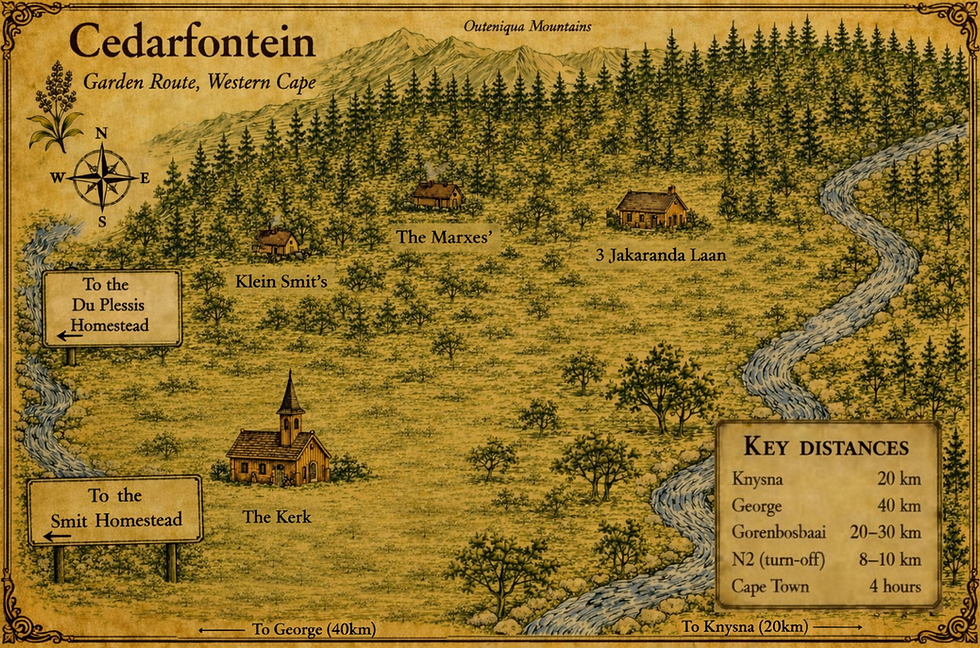
I reached out to the other authors in January or February this year (2026) and asked if anyone would like their ancestors to be founding members of the town, and Allyson said yes!
That started a long string of messages back and forth about her Hennie Du Plessis in The Doctor's Burden who is like a father figure to Dr. Marissa Rossouw.
I loved getting to write about Hennie's ancestors in my book. Including the famous Du Plessis bobotie recipe. Allyson has sent us an image below of it.
Dienece: What is that side dish next to the individual serving of bobotie? It looks a bit like rice and raisins?
Allyson: It's white rice cooked with turmeric and raisins. It’s common to serve the yellow rice with Bobotie!
Dienece: Good to know. Thanks for sharing that.
Readers, there is also a leopard's tooth in both of our stories, but we don't want to give everything away. You'll have to read our stories to find out about how the Du Plessis family got the heirloom leopard's tooth, and what they do with it!
However, if you'd like a copy of the Du Plessis Family's famous bobotie recipe, you can find in the series recipe book for free!
Again, thank you for being with us today, Allyson. I loved collaborating with you this year, and I loved what you did with The Doctor's Burden.
Readers, this doesn't have to be the end! If you have any questions for Allyson, pop them in the comments. And don't forget to check out her great book, The Doctor's Burden!


Comments